
Temporary Modular Office Buildings in California:
What to Know Before You Build
When a project needs professional office space fast — and permanent construction isn’t the answer — temporary modular buildings deliver. Here’s how they work, who uses them, and what sets a quality build apart.
Factory-direct modular building manufacturer · Serving all of California since 1983
A temporary modular office building is a factory-built, fully operational workspace structure designed to be installed on your site, used for months or years, and relocated or removed when the project is complete. It looks and functions like a permanent office. The difference is how it gets there — and how much faster and more cost-effectively it arrives compared to conventional construction.
In California, temporary modular office buildings are used across construction, government, education, healthcare, energy, and commercial development. The applications are as varied as the organizations using them — from a two-office field headquarters on a remote pipeline project to a full multi-room administrative complex for a school district managing a campus renovation.
API Trailers (Atlas Performance Industries, Inc.) has designed, manufactured, and delivered temporary and permanent modular buildings across California since 1983. This guide covers what temporary modular office buildings are, when they make sense, what the build process looks like, and what to look for when choosing a California modular building company.
Have a project in mind?
Every modular build is different. Call us and we will help you figure out what makes sense for your site, timeline, and budget.
What Is a Temporary Modular Office Building?
A temporary modular office building is a prefabricated structure built in sections inside a controlled factory environment, transported to a project site, and assembled on a foundation or blocking system. Unlike a single-unit office trailer, a modular building can be configured across multiple sections to create any size or layout — open plan offices, private suites, conference rooms, restrooms, reception areas, and break rooms.
The word “temporary” in this context refers to the intended use, not the construction quality. A temporary modular office building is built to the same California Department of Housing and Community Development (DOH) building code standards as a permanent structure. The materials, framing, insulation, electrical systems, and finishes are equivalent to conventional construction. What makes it temporary is that it can be disassembled and relocated at the end of the project — something a stick-built structure cannot do.
When a Temporary Modular Office Building Makes Sense
The right application for a temporary modular office building is any situation where you need professional, code-compliant workspace on a defined timeline — and where the flexibility to relocate or remove the structure at project completion is a genuine advantage.
Construction Projects
Multi-year commercial, infrastructure, or public works projects that need a professional on-site headquarters — larger and more capable than a standard job site trailer, but not worth building permanently.
Campus Renovations
Schools, hospitals, and universities that need to maintain operations while permanent buildings are under construction or renovation. Temporary modular buildings keep staff and administration functional without disrupting the project.
Real Estate Development
Sales offices, leasing centers, and on-site management offices for active development projects. Professional enough to impress buyers and investors, temporary enough to remove when the project sells out.
Government & Municipal
Agencies managing facilities transitions, emergency response coordination, or temporary administrative overflow. California DOH certification and ADA compliance are non-negotiable — and both are standard on every API build.
Energy & Industrial
Remote project sites — pipelines, utilities, oil and gas operations — that need a functional, weatherproof field office for the duration of the project, then removal when operations move on.
Healthcare
Clinics, labs, and administrative facilities managing expansion or renovation. ADA compliance is mandatory in healthcare applications — every API Trailers modular build meets current ADA standards.
How the Build Process Works in California
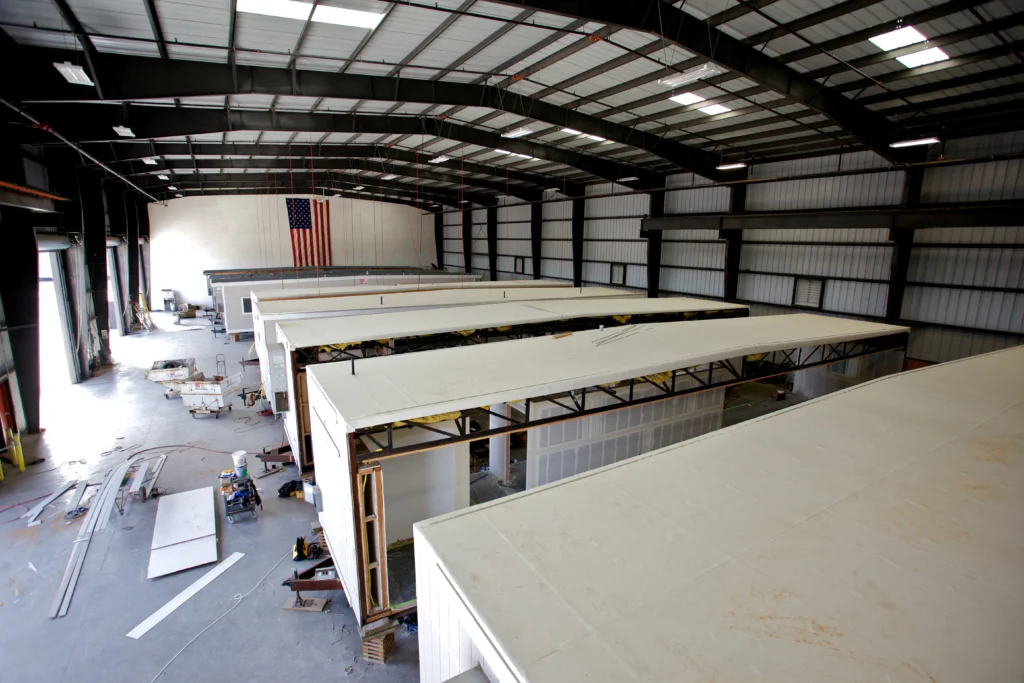
One of the most important advantages of modular construction in California is that site work and factory construction happen simultaneously. While your foundation, utilities, and site preparation are being completed on your property, your building is being constructed inside API’s factory in Santa Maria. By the time your site is ready, your building is ready. That parallel timeline compresses the overall project schedule significantly compared to conventional construction, where site work must be complete before a single wall goes up.
Step 1: Design and Configuration
The process starts with a conversation about your space needs — headcount, layout preferences, required features (restrooms, conference rooms, ADA accessibility), and site conditions. API Trailers designs the floor plan in-house and can customize any configuration. There is no catalog you are limited to. Every build is specific to the project.
Step 2: Factory Construction
Once the design is approved, construction begins in API’s Santa Maria facility. Factory construction offers a quality control advantage that on-site construction cannot match — work happens in a controlled environment, unaffected by weather, with consistent material handling and inspection at every stage. California DOH inspectors certify the build before it leaves the factory.
Step 3: Site Preparation
While the building is being constructed, site preparation runs concurrently — grading, foundation or blocking, utility rough-ins, and any permitting required by your local California jurisdiction. Your project manager coordinates site readiness with the factory build timeline so both are complete at the same time.
Step 4: Delivery and Assembly
API Trailers’ licensed, bonded, and insured delivery team transports the building sections to your site and assembles them on your prepared foundation. Connections between sections are sealed, finished, and inspected. Utility connections are completed. The building is ready for occupancy.
Step 5: Removal or Permanent Installation
At the end of the project, temporary modular buildings are disassembled and removed. If the project’s needs change and permanent installation becomes the right decision, the building can be permitted and finished accordingly — the structure itself does not change, only the permitting classification does.
What to Look for in a California Modular Building Company
Not every company advertising modular buildings in California actually builds them. Many are dealers sourcing units from third-party manufacturers, which adds cost, reduces customization, and removes direct accountability from the build process. Before committing to a modular building company for a California project, confirm the following:
| What to Confirm | Why It Matters |
|---|---|
| Do they manufacture in-house? | Factory-direct means you deal directly with the builder. No middleman, no markup, full accountability for build quality. |
| Are their buildings California DOH certified? | Required for government, school, and healthcare applications. Confirms the build meets California’s structural, electrical, and safety standards. |
| Are they ADA compliant? | Mandatory for any commercial, government, or public-facing application in California. Confirm in writing. |
| Do they handle delivery and installation? | In-house delivery teams with California experience understand site access challenges, local permitting environments, and DOH compliance requirements. |
| What does their California project portfolio look like? | Completed California projects across multiple industries demonstrate real capability — not just catalog units. |
API Trailers: California’s Factory-Direct Modular Building Company
API Trailers (Atlas Performance Industries, Inc.) is one of the few California companies that designs, manufactures, leases, and sells modular buildings entirely in-house. Every building is designed at our Santa Maria facility, built in our factory, delivered by our licensed and insured team, and installed by people who built it. There is no third-party manufacturer. No dealer chain. No uncertainty about who is accountable when something needs to be resolved.
API Trailers has been serving California contractors, developers, government agencies, schools, and businesses since 1983. California DOH certification and full ADA compliance are standard on every build.
Completed California Modular Building Projects
- UC Merced — University of California
- Santa Rosa Fire Station
- West Basin Municipal Water District, El Segundo
- YMCA, Santa Maria
- Regional Wastewater Training Facility, Santa Clara
- Woods Humane Society, Atascadero
- Crisis Stabilization Unit, San Luis Obispo
- California State Parks Nature Education Facility, Carpinteria
- Epoch Winery, Templeton
- UCSB AS Bike Shop, Santa Barbara
- New Cuyama Library
- Payless Car Rental, South San Francisco
- Santa Barbara County Fire Station, Sisquoc
- USFS Rock Creek Barracks, Mammoth Lakes
- Port of Long Beach — Multi-Wide Office Trailers
- Cal Poly AG Department Housing, San Luis Obispo
Frequently Asked Questions
Tell us about your project.
Every temporary modular office building starts with a conversation. No pressure, no obligation — just a straight answer about what makes sense for your site, timeline, and application. API Trailers has been doing this in California since 1983.